Why Meta Ads in 2025 Rarely Reach Who You Expect

We didn't believe the "hyper-personalization" hype, so we analyzed 211,358 Meta ads to see where the algorithm actually sends your budget. The results? 70% of ads are just clustering in a safe demographic middle. It’s not smart optimization—it’s risk avoidance at scale. Personalization, it turns out, is surprisingly average.
To understand who is actually reached when advertisers “let the algorithm decide,” we analyzed 211,358 Meta ads from the +/- 100 largest advertisers in the Netherlands, all deployed with broad targeting. We did not evaluate ads on quality or performance. We looked only at outcomes: the gender distribution of the reached audience, the average age, and recurring patterns in visuals and copy. What emerges is not a story of precision, but of concentration.
What Happens When You Advertise Broadly
In roughly 55% of ads, advertisers deliberately surrendered age and gender targeting to the algorithm. The logic is familiar: broader reach, more flexibility, smarter optimization.
But when we plot these ads by gender balance (X-axis) and average age (Y-axis), the result is strikingly consistent. Across almost all industries, the majority of ads cluster in the same demographic zone: an audience between 35 and 50 years old, with a relatively balanced gender split. This is not a coincidence. It is the default.
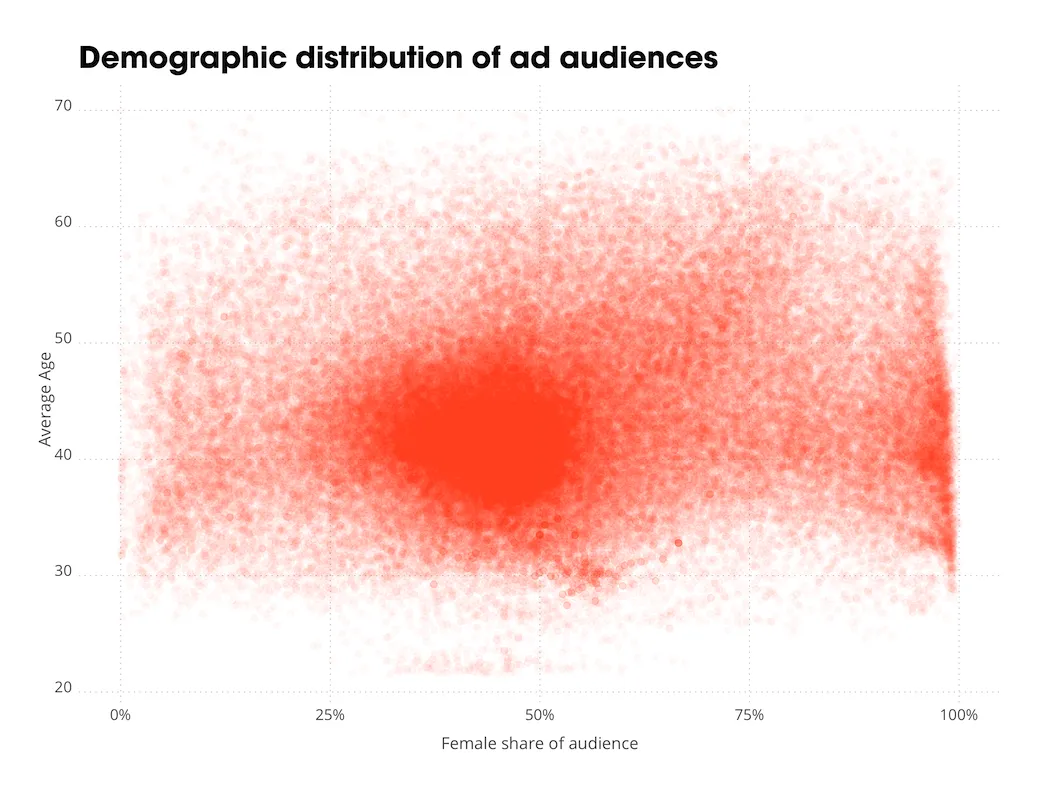
Ads that do not send strong signals through language, imagery, or context are optimized toward the largest group with the lowest risk of rejection. Neutral ads drift toward neutral audiences. And once they arrive there, optimization reinforces the pattern. The result is a self-fulfilling system. In practice:
- Almost 70% of ads reached an audience with an average age between 35-50;
- Only 1.2% of ads reached an audience averaging under 25;
- Just 9.5% reached an audience older than 55.
The edges of the market are not competitive. They are empty.
The Middle Is Not Strategic, It’s Automatic
This concentration is often framed as the outcome of “market realities” or “platform dynamics.” But that framing is convenient. The truth is simpler and more uncomfortable: most advertisers design themselves into the middle.
When creative avoids strong cultural signals, avoids specificity, avoids tension, and avoids identity, the algorithm has no reason to push it anywhere but the center. What looks like smart optimization is often just risk avoidance at scale. The middle is not where brands deliberately choose to be. It is where they end up when they choose not to choose.
Which Brands Escape the Middle
At brand level, the pattern becomes even clearer. Within broadly targeted campaigns, very few advertisers consistently escape the demographic center. In our dataset, only six out of one hundred brands had more than 10% of their ads reach an audience with an average age under 30: Uber Eats, IKEA, Too Good To Go, GetYourGuide, Rituals, and HBO Max.
When we define structural young reach more strictly, as a reach-weighted average age under 30, only one brand remains: Uber Eats.
Top 10 Brands Reaching the Youngest Audience
Brands with the lowest mean weighted audience age in 2025
At the other end of the spectrum, the picture is slightly less extreme. 44 brands managed to reach an audience aged 55+ with around 10% of their ads. Older reach is still rare, but clearly easier to achieve than younger reach. Youth, it turns out, is not elusive. It is actively avoided by the system.
Falling Outside the Middle Makes You Visible
The ads that do escape the demographic comfort zone do so not through targeting tweaks, but through fundamentally different communication:
Reaching Younger Audiences: Recognition Over Explanation
Ads that reach younger audiences behave less like advertising and more like native feed content. They show moments, identity, culture, or emotion, not instructions or arguments.







What stands out in these examples is clear: IKEA and Picnic don’t sell products; they sell situations. National-Nederlanden promotes a podcast instead of an insurance policy. Defensie talks about who you could become, not what you must do.
These ads explain very little. They leave room for interpretation. Recognition comes before persuasion. Most are vertical, culturally coded, and indistinguishable in tone from content shared by friends or creators. For younger audiences, familiarity matters more than clarity.
Reaching Older Audiences: Guidance Over Surprise
Ads that skew older show the opposite pattern. They prioritize calm, predictability, and explanation.







For this audience, brands like KPN, PLUS, Microsoft, and Vattenfall position themselves as guides. Technology is explained step by step. Language reassures rather than excites. Understanding beats novelty.
Gender Is Shaped by How Ads Speak
The same dynamic applies to gender. Ads with a strongly male reach tend to be functional, task-oriented, and performance-driven. Price, specs, efficiency, and outcomes dominate. Ads with a strongly female reach are more contextual. They show use in daily life, atmosphere, relationships, and situations rather than isolated features. Once again, the pattern is consistent: as soon as creative becomes explicit, reach shifts automatically.
Creative Has Become the New Targeting
These differences are not accidental. They reveal a structural shift. As demographic targeting is getting restricted more and more (especially within Meta’s special categories like finance, housing, and employment) creative increasingly takes over the role that targeting once played.
Meta actively accelerates this shift through Advantage+ and similar products, encouraging advertisers to broaden targeting and trust algorithmic optimization. The consequence is clear: who you reach is now determined less by settings and more by signals. Language, imagery, pacing, and tone silently steer ads toward specific demographic outcomes. Where explicit targeting disappears, creative becomes the only remaining steering wheel.
Conclusion: Meta Is Less Personalized Than We Pretend
The Dutch Meta advertising market in 2025 presents itself as deeply personalized. But when we look at actual reach, what we see is concentration. Not because advertisers aim for the same people, but because copy, visuals, formats, and algorithmic optimization quietly push ads toward the same demographic middle.
In a system like this, doing nothing specific is not neutral, it is a decision. The real leverage on Meta no longer lies in more variants or bigger budgets alone. It lies in a more uncomfortable question: Which audiences are you structurally ignoring, and what would happen if you actually designed for them? In a market where everyone reaches the same people, it is deviation and not optimization that creates advantage.