Who Really Dominated Facebook & Instagram Ads in the Netherlands in 2025?

We spent 4 months staring at 389,000 ads because we didn't believe the "hyper-personalization" hype. The truth? A shockingly small group of brands dominated Dutch visibility in 2025. We analyzed millions of impressions to uncover the winners, the dominant industries, and the strategies that determine what you see every day.
How We Measured Visibility at Scale
Scrolling through Facebook or Instagram means encountering an endless stream of ads. But which brands are actually buying the most attention?
To answer that question, we analyzed approximately 389,000 ads from the +/- 100 largest advertisers in the Netherlands in 2025 using Meta’s Ad Library. Our primary metric was reach: the total number of people an ad could have been shown to. This allowed us to look beyond individual creatives and understand visibility at market level.
A Handful of Brands Control the Feed
Looking at the most active advertisers, one thing stands out immediately: the top 10 consists almost entirely of retail, e-commerce, and telecom brands.
There are no banks, no travel brands, no automotive brands, and no FMCG classics in the top tier. The gap is significant. For perspective: Kruidvat reached 8.8× more people than Heineken in 2025.
Combined Reach Top 10
Brands with the most combined reach in 2025
Visibility is extremely concentrated
This concentration becomes even clearer when we look at total reach:
- The top 10 brands accounted for 33% of all reach
- The top 20 brands accounted for 51%
Similar patterns appear within individual industries. Bol.com was 8.4× more visible than Wehkamp, while Ziggo generated by far the most reach among telecom providers. In short, a small group of brands captures a disproportionate share of attention on Meta.
Retail Doesn’t Compete: It Overwhelms Other Industries
Visibility is strongly industry dependent. Roughly 50% of all purchased reach comes from retail and e-commerce brands. Our feeds are largely filled with promotions, deals, and supermarket offers. Other industries follow at a distance:
- Entertainment & media (streaming, films, lotteries): +/-13%
- Telecom: +/-11%
- Automotive & mobility: +/-9%
- Food & beverage (mainly fast food and delivery): +/-8%
- Travel & hospitality: +/-5%
- Financial services: +/-4%
Retail dominance is overwhelming. In fact, a single retail brand (Kruidvat) generated more reach than all banks combined.
Two strategies dominate: volume or evergreen reach
A deeper look at advertising behavior reveals a clear pattern. Nearly all Meta visibility is driven by two fundamentally different strategies.
Number of Ads vs Total Combined Reach
Correlation between volume and visibility in 2025
1. High-volume advertisers (Many variants, small audiences)
These brands rely on volume, targeting, and thousands of ad variations. Examples include:
- Coolblue: 34,500+ ads per year (+/-100 per day);
- Temu Netherlands: +/-21,000 ads;
- KPN: +/-14,000 ads;
- Bol.com: +/-13,000 ads.
Each ad often reaches only dozens or hundreds of people, but collectively they generate massive reach.
Reuse of copy: a few messages dominate the feed
Notably, many high-volume advertisers barely vary their messaging. A small number of core messages is repeated at scale:
- Temu Netherlands: “Temu deals. Beperkte voorraad, geweldige deals” → 8,508 times
- AliExpress: “🎉 Huge Sale! Up to 80% OFF everything!” → 5,794 times
- Viaplay Sport: “Stream de Premier League met meer Nederlanders dan ooit” → 1,936 times
- KPN: “Ontdek hoe de aanleg van glasvezel werkt en wat de voordelen zijn” → 842 times
For these brands, visibility is driven by scale and distribution, not creative variation. Ad fatigue appears to be a secondary concern.
2. Evergreen advertisers (Few variants, massive reach)
In contrast, some brands achieve large-scale reach with relatively few ads:
- Disney+: 227 ads → 173 million reach
- Albert Heijn: +/- 2,000 ads → top-5 reach overall
- Netflix, Videoland, McDonald’s, and major supermarkets follow a similar approach
These brands rely on broad targeting, fewer variants, and high reach per ad.
3. Brands barely using Meta
Finally, a small group of advertisers made minimal use of Meta in 2025:
- Hertog Jan: only 53 ads
- Unilever: just 6 corporate ads
A few ads dominated our feeds
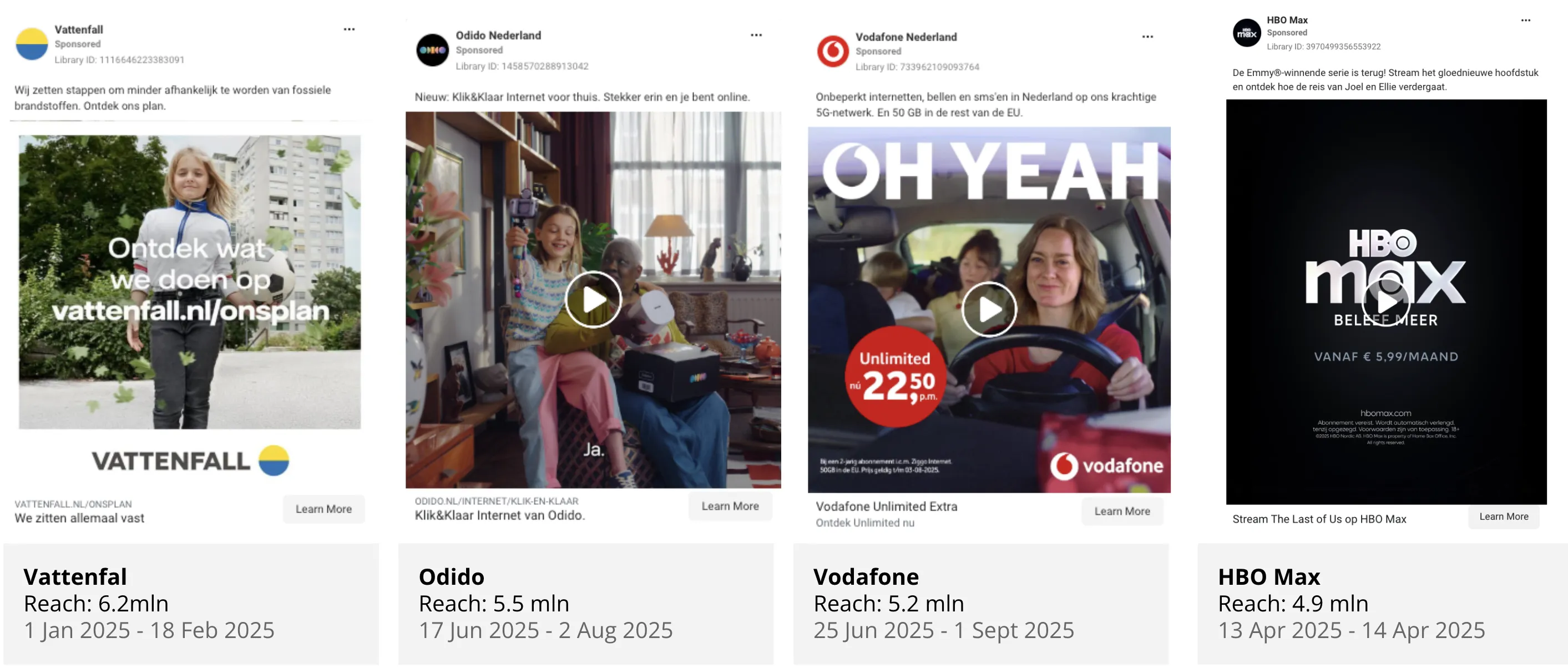
Although high-volume advertisers dominate overall presence, the largest reach spikes came from brands running few ads with broad targeting.
- The single most visible ad reached 6.2 million people
- The median reach across all 389,000 ads was just 4,700
The highest-reach ads came from Vattenfall, followed by Odido, Vodafone, and HBO Max.
When do brands dominate our timelines?
Meta visibility is also highly seasonal. Brands rotate depending on timing and industry:
- Supermarkets: weekly bursts (flyers and promotions)
- Retail & e-commerce: strong growth in Q4 (Black Friday, holidays)
- Travel: peaks in March–April and September
- Telecom: regional “fiber rollout” waves
There is no fixed top 10 throughout the year, dominance shifts with the calendar, campaigns, and industry dynamics. This explains why retail floods your feed in Q4, while airlines and travel brands suddenly take over in spring.
Conclusion
In 2025, the Dutch Meta advertising landscape was dominated by a small group of brands, with retail and e-commerce as clear leaders. Visibility is highly concentrated, and differences within industries are stark: some brands build reach through thousands of ad variations, while others reach nearly the entire country with a handful of broad campaigns.
For users, this explains why certain ads appear for weeks on end, while others are flooded with endless variations from brands like Coolblue, Temu, and loteries. For marketers, it confirms that there are multiple paths to mass reach. Success depends not only on strategy, but also on scale and timing. Seasonal dynamics continuously shift the balance of power throughout the year.
Ultimately, visibility on Meta is not accidental, it is the result of deliberate choices.